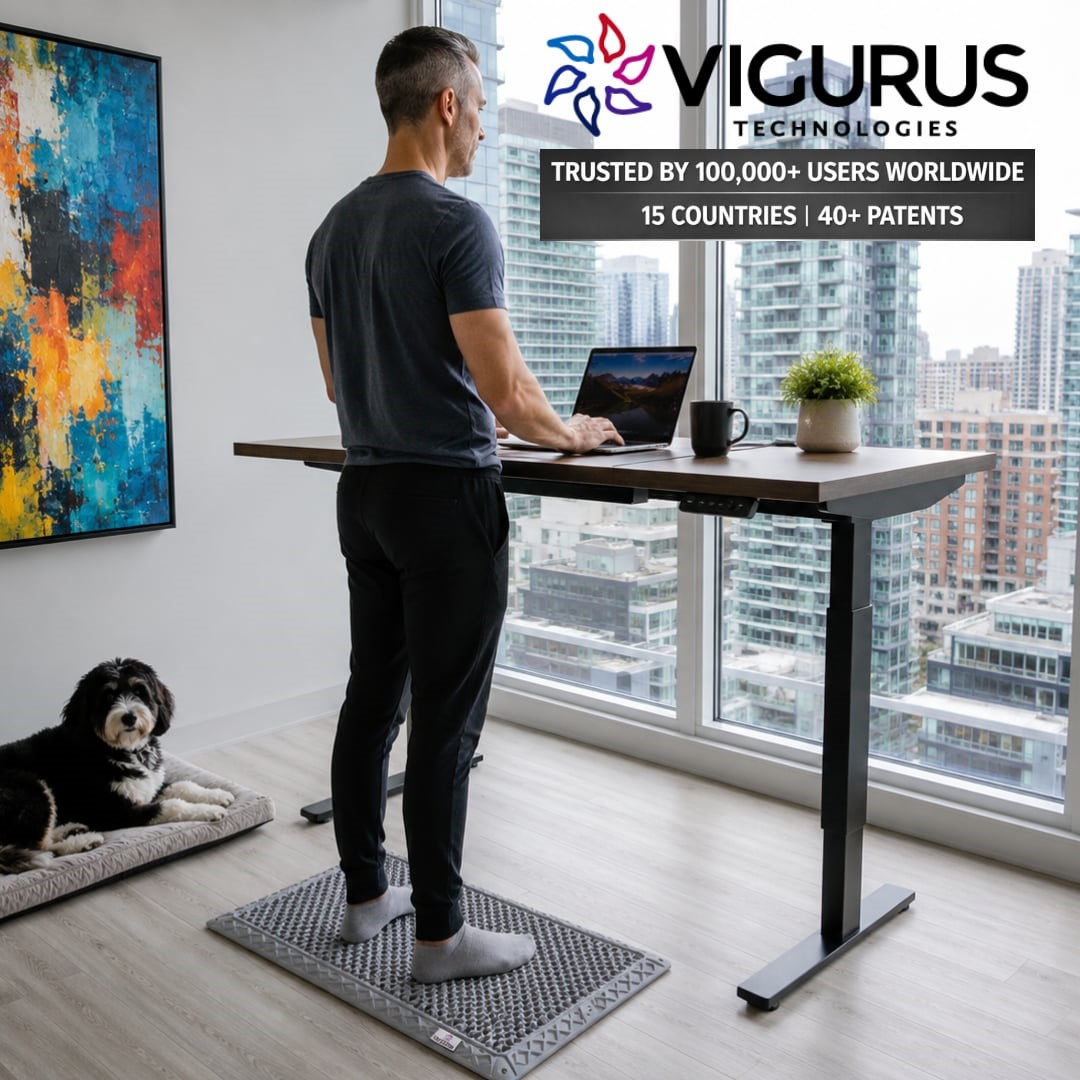
Standing desks have transformed the modern workplace. More people are choosing to stand while working to reduce the effects of prolonged sitting, improve focus, and stay more active throughout the day.
But there is one problem many people discover after switching to a standing desk.
Standing on a hard floor for hours can become just as uncomfortable as sitting too long.
Your feet begin to ache. Your calves tighten. Your knees become sore. By the end of the day, your hips and lower back may also feel stiff.
That is why choosing the right standing desk mat is just as important as choosing the right standing desk.
Not all anti-fatigue mats work the same way. Some simply add cushioning. Others encourage movement. The best mats help distribute pressure, support natural posture, and reduce fatigue throughout the entire body.
This guide explains what makes a great standing desk mat and why SP1KE™ Standing Mats offer a different approach to comfort.
Quick Answer
The best standing desk mat should do more than cushion your feet. It should reduce pressure, absorb impact, encourage natural movement, support posture, and remain durable over years of daily use. SP1KE™ Standing Mats combine a Tips & Mesh design with hundreds of flexible massage tips, helping redistribute pressure while encouraging continuous micro-movement and sensory stimulation.
Why Standing Still Causes Fatigue
Standing is generally healthier than sitting for long periods.
However, standing completely still creates its own challenges.
When you remain in one position:
- Muscles stay contracted.
- Pressure builds under your heels and forefoot.
- Blood circulation slows.
- Your joints receive continuous loading.
Your body naturally begins to lean, shift, or lock your knees to reduce fatigue. These compensations can eventually affect your ankles, knees, hips, and lower back.
This is why standing desk mats are often called anti-fatigue mats. Their purpose is to encourage subtle movement while reducing the stress caused by hard floors.
For more information about prolonged standing, visit the Cleveland Clinic or read our guide to Standing All Day With Foot Pain
What Makes a Great Standing Desk Mat?
The best standing desk mats share several important characteristics.
Pressure Redistribution
Standing places most of your body weight on a relatively small surface area.
Without support, pressure concentrates under the heels and balls of the feet.
A quality mat spreads that pressure over a larger area, reducing stress on individual tissues.
Shock Absorption
Even while standing, your body experiences small impact forces whenever you shift your weight.
These forces travel through your:
- Feet
- Ankles
- Knees
- Hips
- Lower back
A well-designed mat helps moderate these forces before they travel through the body’s kinetic chain.
Encouraging Natural Movement
Research shows that small movements while standing help reduce fatigue.
The best standing mats encourage subtle weight shifts rather than allowing you to remain perfectly still.
These continuous adjustments help activate muscles and reduce prolonged pressure in one location.
Long-Term Durability
Many anti-fatigue mats rely entirely on soft foam.
Soft foam feels comfortable initially but may compress over time.
When that happens, support decreases.
The best standing mats maintain their structure after months or years of daily use.
Types of Standing Desk Mats
Not all standing mats are built the same way.
Traditional Foam Mats
These mats use thick foam to cushion your feet.
They reduce some pressure but may gradually flatten with repeated use.
As the foam compresses, support decreases.
Terrain Mats
Some standing mats include raised ridges, domes, or balance bars.
These features encourage occasional movement and stretching.
Many users enjoy the variety they provide.
However, the stimulation occurs only where the raised features are located.
Dynamic Support Mats
SP1KE™ Standing Mats use a different design philosophy.
Instead of relying on one flat foam surface or a few raised obstacles, the entire standing surface actively responds to your body.
How SP1KE™ Standing Mats Work
SP1KE™ Standing Mats use the company’s globally patented Tips & Mesh™ technology.
Rather than a solid foam surface, the mat contains hundreds of flexible tips connected through an open mesh structure.
Each tip moves independently.
As you shift your weight, the tips respond dynamically.
This creates continuous micro-adjustments throughout the standing surface.
Instead of standing on one unchanging surface, your body receives gentle, ongoing support.
Why the Flexible Tips Matter
The flexible tips are one of the most unique features of SP1KE™.
Unlike decorative bumps found on some products, these tips are designed to move with your body.
Their benefits include:
- Continuous pressure redistribution
- Gentle massage of the soles of the feet
- Sensory stimulation
- Encouragement of subtle movement
- Reduced pressure concentration
The bottoms of our feet contain thousands of nerve endings.
Gentle stimulation from the flexible tips provides sensory feedback to the brain.
This process, called proprioception, helps your body recognize its position in space.
Better sensory awareness encourages natural balance and posture.
Instead of locking into one position, your body continues making small adjustments throughout the day.
Supporting Better Posture
Your feet form the foundation of your body.
When pressure becomes uneven, your body compensates.
These compensations may affect:
- Ankles
- Knees
- Hips
- Lower back
By distributing pressure more evenly, SP1KE™ helps support a more natural standing position.
Good posture begins at the ground.
Closed-Cell Foam: A Cleaner, Longer-Lasting Solution
Material matters just as much as design.
Many anti-fatigue mats use open-cell foam.
Open-cell materials absorb moisture over time.
Sweat, spills, and humidity may remain trapped inside the material.
SP1KE™ uses closed-cell EVA foam.
Closed-cell construction offers several advantages.
It:
- Does not absorb water
- Resists sweat absorption
- Resists mold and mildew
- Dries quickly
- Is washable
- Helps reduce odors
These qualities make SP1KE™ an excellent choice for:
- Home offices
- Corporate offices
- Clinics
- Workshops
- Manufacturing facilities
- Kitchens
- Garages
Built for Everyday Use
SP1KE™ products are lightweight and portable.
You can easily move them between locations.
They are designed for comfort wherever you:
- Stand
- Sit
- Kneel
- Exercise
The closed-cell construction also helps the mat maintain its performance over time.
Many traditional foam mats gradually lose resilience.
SP1KE™ is designed for long-term durability.
Who Benefits from a Standing Desk Mat?
Standing mats are ideal for anyone who spends long periods on their feet, including:
- Office workers
- Designers
- Engineers
- Teachers
- Pharmacists
- Retail employees
- Cashiers
- Receptionists
- Laboratory technicians
- Healthcare professionals
Even people working from home often notice reduced fatigue after adding a supportive standing mat.
Why SP1KE™ Takes a Different Approach
Many anti-fatigue mats focus primarily on cushioning.
SP1KE™ combines several design principles into one product.
These include:
- Dynamic pressure redistribution
- Flexible massage tips
- Sensory stimulation
- Shock moderation
- Closed-cell waterproof materials
- Long-term durability
- Easy cleaning
- Odor resistance
Rather than simply standing on a softer surface, users experience continuous support that adapts to natural movement.
Learn more about our technology on our About Us page
Explore the full SP1KE™ collection
Frequently Asked Questions
What is the best mat for a standing desk?
The best standing desk mat redistributes pressure, encourages movement, supports posture, and remains durable over time.
Why are massage tips useful?
Massage tips provide gentle sensory stimulation that encourages subtle movement and helps reduce prolonged pressure on the feet.
Does a standing desk mat improve posture?
A supportive mat may encourage more natural weight distribution and reduce compensatory movements associated with prolonged standing.
Why is closed-cell foam important?
Closed-cell foam does not absorb water or sweat, making it easier to clean and more resistant to mold, mildew, and odors.
Can a standing desk mat help reduce fatigue?
Many people find that anti-fatigue mats reduce discomfort associated with prolonged standing by encouraging movement and reducing concentrated pressure.
Related Reading
Learn more about foot health and prolonged standing:
For additional information about workplace ergonomics, visit the National Institute for Occupational Safety and Health or the Cleveland Clinic.
Final Thoughts
The best standing desk mat should do more than provide cushioning.
It should help your body stay comfortable through movement, pressure redistribution, and lasting support.
SP1KE™ Standing Mats combine Tips & Mesh technology, flexible massage tips, and durable closed-cell EVA foam to create a standing surface designed for long hours at your desk.
Whether you work from home, in an office, or spend your day moving between workstations, choosing the right standing mat can make a meaningful difference in your daily comfort and wellbeing.