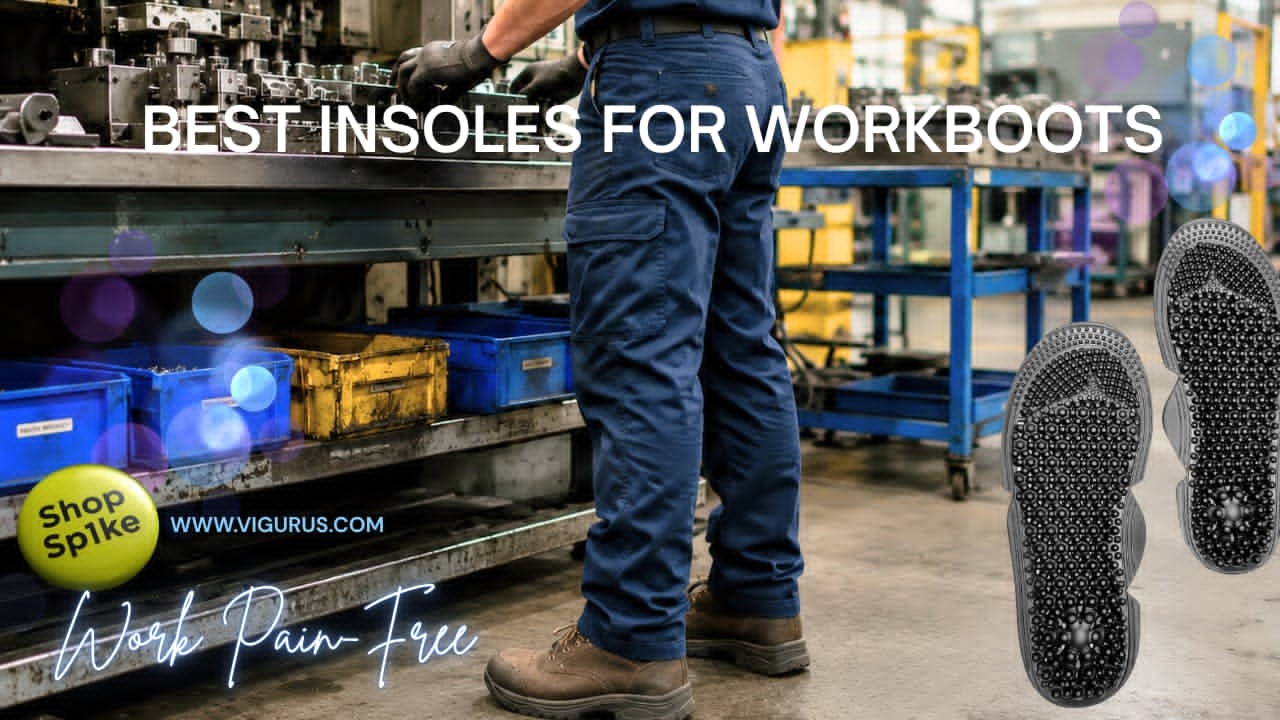
If your job keeps you on hard surfaces all day, you already know the feeling.
Your feet ache.
Your legs feel heavy.
Your lower back becomes stiff.
And by the end of your shift, even walking to your car feels like work.
Factory workers, warehouse staff, grocery store employees, cashiers, nurses, mechanics, tradespeople, and production workers all face the same challenge.
Concrete floors do not absorb shock.
Your body absorbs it instead.
This guide explains why standing on concrete causes fatigue and pain, what to look for in a work insole, and why some materials and designs perform better than others.
Quick Answer: What Are the Best Insoles for Standing on Concrete?
For workers spending long hours on hard surfaces, the best insoles should provide:
- Shock absorption
- Pressure redistribution
- Arch support
- Durability
- Moisture resistance
- Odor resistance
Two commonly recommended options are:
- SP1KE™ Insoles
- Dr. Scholl’s® Comfort & Energy Work Insoles
Both are designed for people who spend long hours on their feet.
However, they approach the problem differently.
Why Concrete Floors Cause Foot, Leg, and Back Pain
Concrete is one of the hardest surfaces people work on.
Unlike grass, carpet, or rubber flooring, concrete does not compress.
Every step creates force.
That force travels through:
- Feet
- Ankles
- Knees
- Hips
- Lower back
This is called the kinetic chain.
Over time, repetitive shock can contribute to:
- Foot fatigue
- Heel pain
- Knee discomfort
- Lower back pain
- Muscle strain
The Hidden Problem: Most Insoles Eventually Flatten
Many insoles feel comfortable on day one.
The challenge is what happens after weeks or months of use.
Traditional foam compresses.
As foam compresses:
- Support decreases
- Alignment changes
- Shock absorption declines
- Pressure increases
For workers on concrete floors, durability matters just as much as cushioning.
What Makes a Good Work Insole?
Shock Absorption
Standing and walking on concrete creates constant impact.
A quality insole helps moderate those forces before they reach the knees and lower back.
Pressure Redistribution
The goal is not simply softness.
The goal is spreading load across the foot.
Reducing pressure points helps reduce fatigue.
Arch Support
Proper arch support helps maintain alignment.
Alignment influences:
- Knees
- Hips
- Spine
Good support helps prevent excessive inward rolling of the foot.
Durability
Workers often wear the same boots every day.
An insole must maintain performance over time.
Moisture and Odor Resistance
Work boots trap heat.
Heat creates sweat.
Sweat creates odor.
Material choice plays a major role in hygiene.
SP1KE™ Insoles for Concrete Floors
SP1KE™ insoles are developed by Vigurus Technologies Inc..
Unlike traditional foam insoles, SP1KE™ uses a patented Tips & Mesh structure.
Learn more:
How the Tips & Mesh System Works
The SP1KE™ design uses hundreds of flexible tips connected through an open mesh structure.
Rather than collapsing under load, the structure responds dynamically.
Benefits include:
- Pressure redistribution
- Shock moderation
- Airflow
- Consistent support
The design helps prevent bottoming out under heavy loads.
Why SP1KE™ Works Well for Flat Feet
Many workers have flat feet or low arches.
Flat feet often increase pressure on:
- Heels
- Arches
- Knees
SP1KE™ adapts to foot shape through progressive resistance.
The structure engages more support as load increases.
This allows support without excessive rigidity.
Sensory Activation and Stability
One unique feature of SP1KE™ is its flexible stimulation tips.
These tips provide tactile feedback to the sole.
This may help:
- Improve proprioception
- Enhance balance awareness
- Encourage muscle activation
- Support natural positioning
Better positioning may help reduce compensatory movement patterns.
Closed-Cell Waterproof Foam
SP1KE™ uses closed-cell waterproof foam.
This is important because the material:
- Does not absorb sweat
- Does not absorb water
- Resists mold
- Resists mildew
- Dries quickly
Unlike absorbent foams, moisture cannot penetrate the material.
Why SP1KE™ Insoles Stay Odor Free
Odor develops when moisture becomes trapped.
Trapped moisture allows bacteria to multiply.
Because SP1KE™ does not absorb moisture:
- Odor buildup is minimized
- Cleaning is easier
- Hygiene improves
Many workers report replacing boots before replacing their SP1KE™ insoles.
Durability is one of the strongest advantages of closed-cell construction.
Dr. Scholl’s® Comfort & Energy Work Insoles
Dr. Scholl’s has a long history in the insole market.
Their work-specific product is:
Dr. Scholl’s® Comfort & Energy Work Insoles
Official product information:
These insoles are designed for workers who spend long hours standing.
Benefits of Dr. Scholl’s Work Insoles
Features include:
- Shock absorption
- Reinforced arch support
- Cushioning foam
- Energy-return design
The insoles are designed to help reduce:
- Foot fatigue
- Leg fatigue
- Discomfort from hard surfaces
Many workers find them comfortable.
Different Material Approaches
Dr. Scholl’s relies primarily on foam-based cushioning.
SP1KE™ relies on a structural grid system and closed-cell material.
Both approaches seek to improve comfort.
The key difference is how they manage long-term compression, moisture, and airflow.
Comparison: SP1KE™ vs Dr. Scholl’s Work Insoles
| Feature | SP1KE™ | Dr. Scholl’s Work |
| Shock Moderation | Dynamic grid structure | Cushioning foam |
| Arch Support | Adaptive support | Reinforced arch columns |
| Moisture Absorption | None | Foam-based |
| Odor Resistance | Closed-cell waterproof material | Odor management layer |
| Washable | Yes | Limited |
| Mold/Mildew Resistance | Yes | Foam dependent |
| Durability | Extremely high | Moderate |
| Airflow | Open mesh design | Limited |
Both products are designed to improve comfort for workers.
SP1KE™ offers additional advantages in durability, moisture resistance, and airflow.
Why Insoles Affect More Than Your Feet
The feet are the foundation of the body.
Poor support affects:
- Knees
- Hips
- Lower back
For a deeper understanding of how foot mechanics affect overall comfort, read:
Standing All Day With Foot Pain
Our Complete Guide to Foot Pain
Who Benefits Most From Work Insoles?
Work insoles are especially valuable for:
- Factory workers
- Warehouse employees
- Grocery store workers
- Cashiers
- Nurses
- Tradespeople
- Mechanics
- Production line workers
Any job involving concrete floors can benefit from improved support.
Frequently Asked Questions
What are the best insoles for concrete floors?
SP1KE™ and Dr. Scholl’s Comfort & Energy Work Insoles are two popular options for workers on hard surfaces.
Why do insoles smell after a few weeks?
Most foam insoles absorb sweat and moisture. Trapped moisture encourages bacterial growth and odor.
What makes SP1KE™ odor resistant?
SP1KE™ uses closed-cell waterproof foam that does not absorb moisture.
Are SP1KE™ insoles good for flat feet?
The adaptive Tips & Mesh structure provides support while allowing the foot to engage naturally.
How long do work insoles last?
Lifespan varies by material and usage. Closed-cell structural materials generally resist breakdown longer than traditional foam.
Final Thoughts
Standing on concrete all day places significant stress on the body.
The right insole should do more than provide cushioning.
It should help manage shock, support alignment, resist moisture, and maintain performance over time.
SP1KE™ combines a patented structural design with closed-cell waterproof materials to provide long-lasting support, odor resistance, and durability for demanding work environments.