Knee pain is one of the most common complaints among runners.
It often develops gradually.
It may start as mild soreness.
Over time, it can affect performance and daily movement.
Many runners focus on shoes.
Few consider what is inside them.
Proper insoles address the biomechanical root causes of lower-body pain.
This guide explains why knee pain happens and how structured insoles like SP1KE™ may help.
Why Runners Experience Knee Pain
Running generates impact.
With every step, your body absorbs force.
Impact can reach up to three times your body weight.
That force travels through:
- Feet
- Ankles
- Knees
- Hips
- Lower back
If alignment is off at the foot, the knee compensates.
Repeated compensation leads to strain.
The Biomechanics Behind Runner’s Knee
The knee is a hinge joint.
It depends on alignment below and above it.
If the foot rolls inward excessively, the knee rotates inward.
If the foot rolls outward, the knee may compensate differently.
These small misalignments accumulate.
Over time, cartilage and tendons experience stress.
Pain follows.
The Most Critical Reasons Runners Need Proper Insoles
Correcting Biomechanical Issues
Overpronation means the foot rolls too far inward.
Supination means it rolls outward.
Both create joint stress.
Proper insoles gently guide the foot toward a neutral position.
Even weight distribution reduces uneven joint loading.
Balanced load reduces knee strain.
Improved Shock Absorption
Running produces repetitive impact.
Without adequate shock moderation, force travels upward.
Quality insoles help absorb part of that impact.
Reducing shock at the foot reduces stress at the knee.
Hard surfaces amplify impact.
Shock absorption becomes more important.
Pain and Injury Relief
Proper insoles may help reduce excessive load.
Common running-related issues include:
- Runner’s knee
- Shin splints
- Achilles tendinitis
- Plantar fasciitis
Insoles reduce repeated strain on muscles and tendons.
Reducing strain supports recovery.
For broader context, read:
Our Complete Guide to Foot Pain
Stability During Fatigue
As muscles tire, form changes.
The foot may collapse inward.
The arch may drop.
This shifts pressure to the knee.
Supportive insoles maintain foundational stability.
Stability reduces collapse during long runs.
Adapting to Foot Anatomy
Running shoes are designed for general use.
They cannot match every foot type.
Flat feet, high arches, and leg-length differences require tailored support.
Replacing factory liners with structured insoles improves anatomical fit.
Better fit improves alignment.
How SP1KE™ Insoles Address Knee Pain Holistically
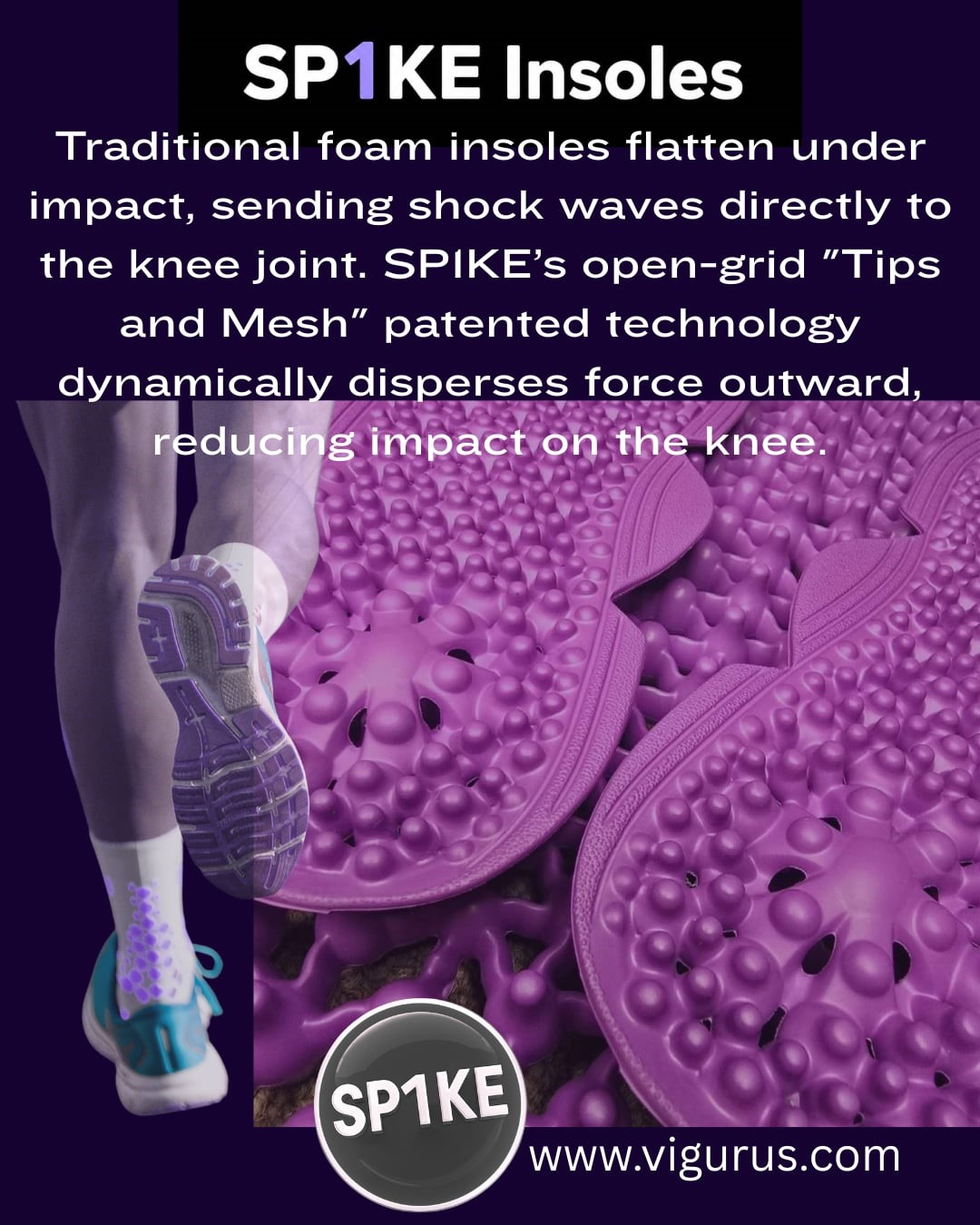
SP1KE™ insoles use a structural Tips & Mesh system.
They are developed by Vigurus Technologies Inc..
Unlike flat factory liners, SP1KE™ maintains shape under load.
Learn More About SP1KE™
Learn More About Our Engineering
Structural Alignment Support
SP1KE™ supports the natural shape of the foot.
Better foot alignment supports:
- Ankles
- Knees
- Hips
- Spine
When the foot remains stable, the knee tracks more naturally.
Reduced twisting lowers joint strain.
Progressive Shock Moderation
Each SP1KE™ tip narrows at the top and widens toward the base.
This creates progressive resistance.
As impact increases, resistance increases.
This moderates shock without flattening.
Consistent shock moderation reduces cumulative stress.
Pressure Redistribution
SP1KE™ distributes weight evenly.
Even distribution reduces high-pressure zones.
High-pressure zones cause compensatory movement.
Reducing compensation reduces knee strain.
Enhanced Sensory Feedback
SP1KE™ includes flexible massaging tips.
These stimulate nerve endings in the sole.
Improved proprioception supports balance.
Better balance reduces compensatory knee rotation.
This sensory activation sets SP1KE™ apart.
Comparison: SP1KE™ vs Dr. Scholl’s Runner’s Knee Orthotics
Dr. Scholl’s Runner’s Knee orthotics are widely available.
Brand link:
https://www.drscholls.ca/en/search/runner%27s+knee
They provide cushioning and targeted support.
They include structured heel components.
They focus on reducing impact.
However, they use foam-based cushioning.
Foam may compress over time.
Compression reduces long-term structural integrity.
SP1KE™ uses closed-cell structural material.
Closed-cell foam:
- Resists compression
- Does not absorb moisture
- Maintains shape longer
- Reduces odor risk
SP1KE™ also adds sensory stimulation.
Dr. Scholl’s focuses primarily on cushioning.
SP1KE™ combines structure, shock moderation, and sensory activation.
Both offer comfort.
SP1KE™ offers durability and adaptive resistance.
Why Durability Matters for Runners
Running creates repetitive impact.
If insoles flatten:
- Alignment shifts
- Shock increases
- Knee strain rises
Durable insoles maintain consistent support.
Consistency reduces biomechanical drift.
SP1KE™ often lasts longer than factory liners.
Durability matters in training cycles.
Knee Pain and Hard Surfaces
Road running increases impact.
Concrete sidewalks amplify shock.
If you also stand long hours, cumulative load increases.
For those who stand for work, read:
Standing All Day With Foot Pain
Managing total daily load is important.
When to Consider Insoles for Knee Pain
Consider insoles if you experience:
- Knee soreness after runs
- Pain descending stairs
- Aching after long shifts
- Early fatigue in hips
Insoles support biomechanics.
They are not medical treatment.
Frequently Asked Questions
Can insoles help runner’s knee?
They may reduce mechanical strain contributing to discomfort.
Why does knee pain start at the foot?
Foot alignment affects knee tracking through the kinetic chain.
Are factory liners enough for running?
Factory liners are generic and often lack structured support.
How does SP1KE™ differ from foam insoles?
SP1KE™ uses structural progressive resistance and sensory stimulation.
Should runners replace insoles regularly?
Yes. Durability affects alignment consistency.
Final Thoughts
Knee pain from running often begins with foot mechanics.
Alignment, shock absorption, and stability all matter.
Proper insoles help address these factors.
SP1KE™ combines structural support, progressive shock moderation, and sensory activation.
Understanding biomechanics is a practical step toward reducing knee strain and improving running efficiency.