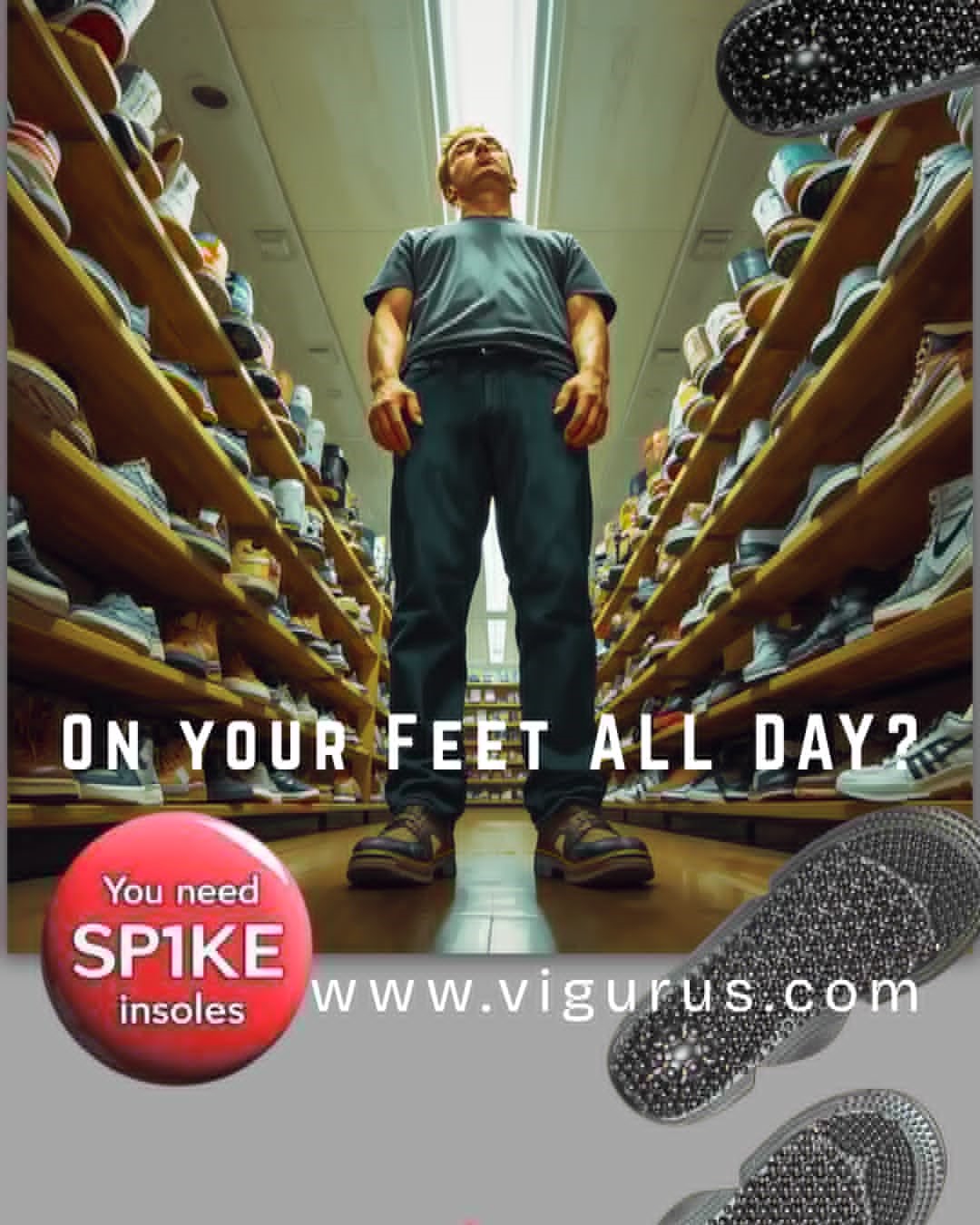
Lower back pain is common in jobs that require long hours on your feet.
Hard surfaces increase stress on the body.
Over time, that stress travels upward.
Understanding how force moves through the body is essential.
This guide explains why standing all day can cause lower back pain and how supportive insoles like SP1KE™ may help reduce strain.
Why Standing All Day Causes Lower Back Pain
Standing is not harmful by itself.
The problem is prolonged static load.
When you stand for hours:
- Muscles fatigue
- Joints compress
- Circulation slows
- Shock accumulates
Hard floors make this worse.
Concrete does not absorb impact.
The body absorbs it instead.
The Shock Pathway: From Foot to Spine
Every step creates force.
That force travels through:
- The foot
- The ankle
- The knee
- The hip
- The lower back
This is called the kinetic chain.
If the foot absorbs shock poorly, the spine compensates.
According to the Cleveland Clinic, prolonged standing may contribute to back discomfort.
The lower lumbar region is especially vulnerable.
How Hard Surfaces Increase Back Strain
Concrete and tile do not compress.
Shoes often compress quickly.
When cushioning flattens, impact increases.
Repeated micro-shock leads to:
- Muscle fatigue
- Spinal compression
- Lower back stiffness
- Compensatory posture
Over time, fatigue becomes pain.
If your job requires standing, read:
Standing All Day With Foot Pain
Foot load directly affects spinal load.
Lower Back Pain and Poor Postural Alignment
The body seeks balance.
If your feet collapse inward or outward:
- Ankles misalign
- Knees rotate
- Hips tilt
- Spine compensates
This misalignment increases muscle strain.
Lower back fatigue often begins at the feet.
For broader context, see:
Our Complete Guide to Foot Pain
The body functions as one system.
Common Symptoms of Back Pain from Standing
- Dull ache in the lower back
- Tight hips
- Stiffness after shifts
- Fatigue in calves
- Relief when sitting
Pain often worsens at the end of the day.
This pattern suggests mechanical overload.
How Insoles May Help Reduce Lower Back Pain
Insoles do not treat spinal conditions.
They may reduce mechanical stress.
They help by:
- Improving structural alignment
- Absorbing shock
- Redistributing pressure
- Supporting circulation
Reducing force at the foot may reduce force at the spine.
How SP1KE™ Insoles Address Lower Back Pain Holistically
SP1KE™ insoles use a structural Tips & Mesh design.
They are developed by Vigurus Technologies Inc..
Unlike soft foam, SP1KE™ maintains structure under load.
Learn more
About our engineering
Improved Postural Alignment
SP1KE™ supports the natural shape of the foot.
Better foot positioning supports:
- Ankles
- Knees
- Hips
- Spine
When alignment improves, twisting reduces.
Reduced twisting may lower back strain.
Alignment affects the entire kinetic chain.
Active Shock Absorption
The structure absorbs impact gradually.
Each tip narrows at the top and widens at the base.
This creates progressive resistance.
As load increases, resistance increases.
This reduces shock waves traveling upward.
Less shock may mean less lumbar compression.
Hard floors amplify impact.
SP1KE™ reduces transmitted force.
Pressure Redistribution and Circulation
SP1KE™ redistributes weight evenly.
It prevents pressure concentration in one area.
Even distribution reduces fatigue.
The flexible massaging tips stimulate the sole.
Stimulation may increase circulation.
Improved circulation reduces fatigue buildup.
Fatigue often leads to altered gait.
Altered gait increases back strain.
Reducing fatigue may help reduce compensatory movements.
Enhanced Sensory Feedback
The soles of the feet contain many nerve receptors.
SP1KE™ tips provide tactile stimulation.
This may enhance proprioception.
Proprioception improves balance awareness.
Better balance reduces compensatory tension.
Compensatory tension often affects the lower back.
Stability at the foot supports stability at the spine.
Holistic Health Benefits Beyond Foot Comfort
SP1KE™ insoles focus on whole-body mechanics.
By improving alignment and reducing shock, they may:
- Reduce joint strain
- Support muscle endurance
- Improve stability
- Lower fatigue levels
Lower fatigue often means better posture.
Better posture reduces lumbar stress.
Reducing stress supports joint health.
Joint health supports mobility.
Mobility supports overall wellness.
Lower Back Pain and Muscle Compensation
When feet fatigue:
- Calves tighten
- Hips shift
- Core disengages
The lower back compensates.
Compensation creates tension.
Over time, tension becomes chronic discomfort.
Structural support reduces compensation triggers.
Why Shock Absorption Matters for the Spine
Each step produces vertical force.
That force compresses spinal discs.
Repeated compression leads to:
- Muscle guarding
- Stiffness
- Fatigue
Reducing transmitted shock may reduce cumulative stress.
SP1KE™ insoles focus on shock moderation, not just softness.
Back Pain in Specific Professions
Common high-risk occupations include:
- Nurses
- Retail workers
- Teachers
- Warehouse staff
- Construction workers
Hard floors and long shifts increase cumulative load.
Reducing daily mechanical strain is essential.
Foam vs Structural Insoles for Back Pain
Foam:
- Compresses over time
- May flatten
- Offers passive cushioning
Structural systems:
- Maintain integrity
- Redistribute load
- Provide dynamic response
Durability matters in long shifts.
Frequently Asked Questions
Can insoles reduce lower back pain?
They may reduce mechanical stress contributing to discomfort.
Why does standing cause back pain?
Prolonged load and shock increase spinal strain.
How do SP1KE™ insoles help alignment?
They support foot structure and improve kinetic chain balance.
Do massaging tips help circulation?
They may stimulate nerve endings and encourage blood flow.
Are insoles enough for severe back pain?
Consult a healthcare professional for persistent or severe pain.
Final Thoughts
Lower back pain from standing is often mechanical.
Shock, fatigue, and misalignment accumulate over time.
Reducing force at the foot may reduce strain at the spine.
SP1KE™ insoles focus on structural alignment, shock moderation, and sensory activation.
Understanding how force travels through your body is a meaningful step toward reducing daily back strain.