Quick Answer
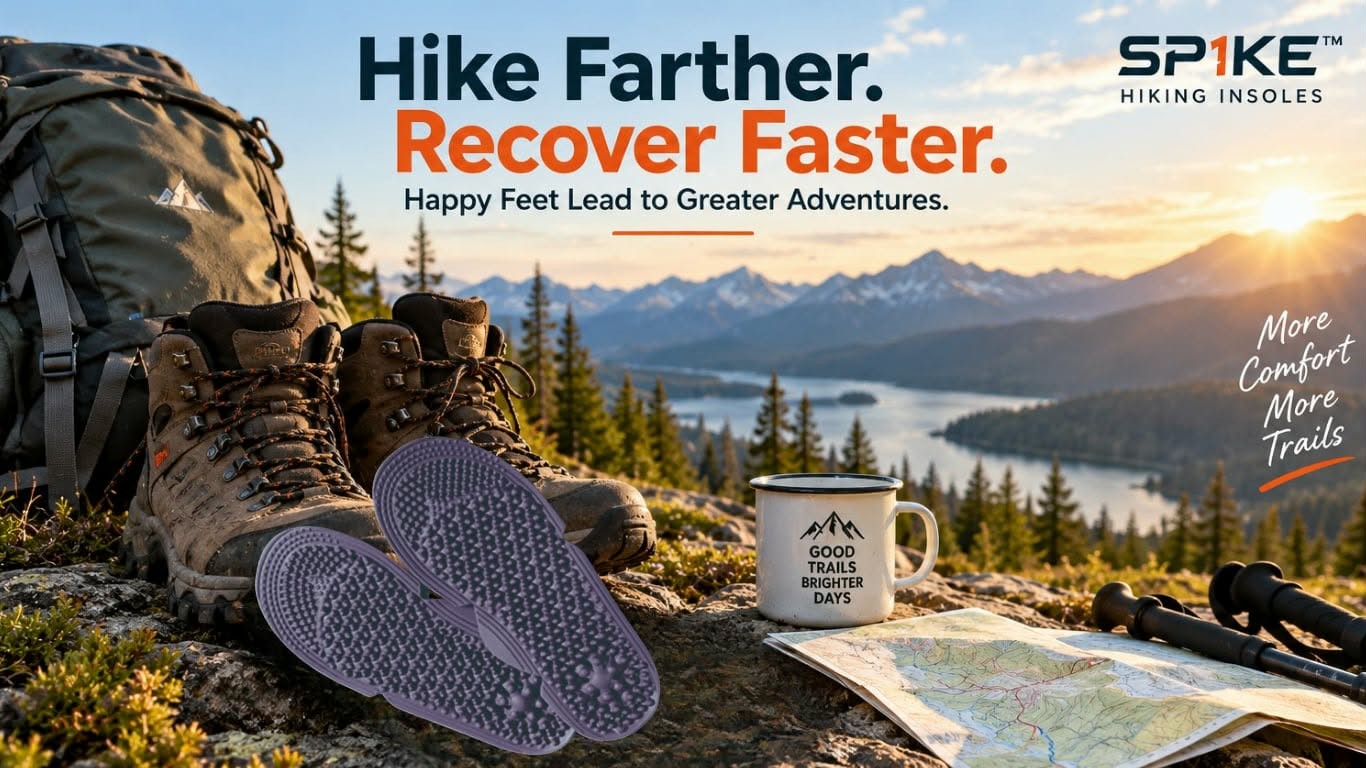
The best hiking insoles do much more than add cushioning. They help redistribute pressure, moderate repetitive impact, support natural foot movement, and stay comfortable through changing trail conditions. SP1KE™ Hiking Insoles combine Tips & Mesh technology with closed-cell waterproof EVA foam to provide durable, odor-resistant comfort for hikers of every experience level.
Key Takeaways
Quality hiking insoles help redistribute pressure across your feet during long hikes.
Factory boot insoles are designed for general fit, not long-distance trail comfort.
Proper insoles may help reduce fatigue in the feet, knees, hips, and lower back.
Closed-cell EVA foam resists water, sweat, mud, mold, and mildew.
SP1KE™ Tips & Mesh technology provides dynamic support through hundreds of flexible massage tips.
Why Your Insoles Matter More Than You Think
Most hikers spend weeks choosing the right boots.
They compare brands, waterproof membranes, tread patterns, and ankle support.
Then they lace up their new boots and head for the trail.
Few hikers think about what is inside those boots.
Yet the insole is the only part of your footwear that stays in direct contact with your foot all day.
Every step begins there.
Every climb.
Every descent.
Every rocky trail.
Every stream crossing.
Every mile depends on the comfort and support beneath your feet.
When your feet feel good, the entire hike becomes more enjoyable.
When they hurt, every step becomes harder.
That is why experienced hikers often upgrade their insoles long before replacing their boots.
Hiking Is Different From Everyday Walking
Walking around your neighbourhood is predictable.
Hiking is not.
Trails constantly challenge your body.
You walk over:
Loose gravel
Tree roots
Rocky terrain
Mud
Sand
Uneven ground
Steep climbs
Long descents
Every change in terrain forces your feet to stabilize your body.
A moderate day hike often includes between 15,000 and 25,000 steps.
Backpacking trips can easily exceed that.
Each step sends force through your:
Feet
Ankles
Knees
Hips
Lower back
This series of connected joints is called the kinetic chain.
When one area becomes tired, the rest of the body often compensates.
Proper foot support helps the entire kinetic chain work more efficiently.
Common Foot Problems Hikers Experience
Even experienced hikers experience sore feet after long days on the trail.
Many of these problems develop gradually.
The right insole cannot prevent every injury.
However, it can improve comfort and help reduce excessive pressure in high-load areas.
Heel Fatigue
Your heel absorbs repeated impact throughout the day.
Long descents increase this loading.
Pressure builds with every step.
Supportive insoles help distribute that pressure more evenly.
Arch Fatigue
The arch acts like a natural spring.
It supports your body over changing terrain.
After many miles, those muscles become tired.
Good insoles help spread force across the foot instead of concentrating it in one location.
Hot Spots and Blisters
Most blisters begin as friction.
Friction creates heat.
Heat creates hot spots.
If ignored, those hot spots often become painful blisters.
Properly fitted footwear is essential.
Supportive insoles may also help reduce unnecessary movement inside the boot.
Knee and Hip Fatigue
Your knees depend on stable feet.
If your feet become unstable, your knees and hips compensate.
Over many miles, those small adjustments add up.
Supporting your feet helps support the joints above them.
Lower Back Discomfort
Your feet are the foundation of your posture.
As fatigue increases, many hikers unknowingly change the way they walk.
Those changes travel upward through the body.
Comfort begins where your body meets the trail.
Why Most Factory Insoles Are Only a Starting Point
Most hiking boots include a factory insole.
These insoles are not poor quality.
They simply have a different purpose.
Manufacturers design them to fit the widest possible range of people.
No two hikers have identical feet.
Some have:
High arches
Flat feet
Wide feet
Narrow feet
Others carry heavier packs or hike longer distances.
A single factory insole cannot perfectly support every foot.
That is why upgrading your insole is one of the easiest ways to improve hiking comfort without replacing your boots.
What Makes a Great Hiking Insole?
Not every hiking insole performs the same.
The best designs combine several important characteristics.
Pressure Redistribution
Long hikes create pressure beneath the heel and forefoot.
Quality insoles help spread that pressure over a larger surface area.
This reduces concentrated loading during long days on the trail.
Shock Moderation
Every downhill step increases impact.
Supportive insoles help moderate those repetitive forces before they travel through your legs and lower back.
Stability
Trails are rarely flat.
Your feet constantly adjust to changing terrain.
Good insoles support those natural movements without restricting them.
Durability
Outdoor gear should last.
Many traditional foam insoles gradually flatten.
As they compress, support decreases.
A durable insole maintains its structure through many adventures.
Waterproof Performance
Weather changes quickly outdoors.
Morning dew, stream crossings, and unexpected rain are part of hiking.
Materials matter.
A hiking insole should continue performing even when conditions become wet.
What Experienced Hikers Carry That Beginners Often Don’t
One of the biggest differences between new hikers and experienced hikers is not fitness.
It is preparation.
Experienced hikers know that comfort helps them enjoy longer adventures.
Beginner Hiker
Focuses only on boots
Waits until feet hurt
Takes fewer recovery breaks
Sits on rocks or wet ground
Replaces boots first
Experienced Hiker
Focuses on boots and insoles
Prevents discomfort before it starts
Uses regular trail breaks to recover
Carries a lightweight trail pad
Often upgrades insoles first
Small upgrades often make the biggest difference after several hours on the trail.
How Many Miles Does Your Foot Travel Inside Your Boot?
Most people think their foot stays perfectly still inside a hiking boot.
It does not.
With every step, your foot moves slightly.
Those tiny movements repeat thousands of times.
Over 20,000 steps, that small movement becomes significant.
It contributes to:
Friction
Heat
Pressure
Muscle fatigue
That is why experienced hikers often pay close attention to both socks and insoles.
The goal is not simply adding cushioning.
The goal is creating a more comfortable environment inside the boot throughout the entire hike.
How SP1KE™ Hiking Insoles Take a Different Approach
SP1KE™ Hiking Insoles were designed differently from traditional foam inserts.
Instead of relying only on cushioning, they combine structure with flexibility.
At the heart of the design is our Tips & Mesh technology.
Hundreds of flexible support tips work together through an open mesh structure.
Rather than compressing like one solid piece of foam, each tip responds independently.
As your weight shifts during the hiking stride, the support surface adapts with you.
This helps redistribute pressure while providing gentle tactile stimulation through the soles of your feet.
The design encourages natural movement instead of simply allowing your foot to sink into soft foam.
Coming in Part 2
In Part 2, you’ll learn:
Why closed-cell waterproof EVA foam is ideal for hiking.
How SP1KE™ insoles resist moisture, mud, mold, mildew, and odors.
A comparison between factory insoles and SP1KE™ technology.
Helpful hiking resources and buying tips.
Frequently Asked Questions.
Related Reading
SP1KE™ Insoles Product Page
About Vigurus Technologies
Complete Guide to Foot Pain
Standing All Day With Foot Pain
Suggested External Resources
American Academy of Orthopaedic Surgeons – Foot and Ankle Health
REI Expert Advice – Hiking and Backpacking Skills