The Complete Guide to SP1KE™ Technology Licensing and Manufacturing Partnerships
Quick Answer: Can Manufacturers License SP1KE™ Technology?
Yes. SP1KE™ technology is available for licensing to manufacturers seeking to develop new products or improve existing designs.
Developed by SP1KE™ Inc. and commercialized through Vigurus Technologies Inc., this patented technology offers a different approach to pressure management and physical support.
Its unique Tips & Mesh construction combines flexible support elements with an open structural grid.
The design responds to movement, distributes loads, and provides dynamic contact with the body.
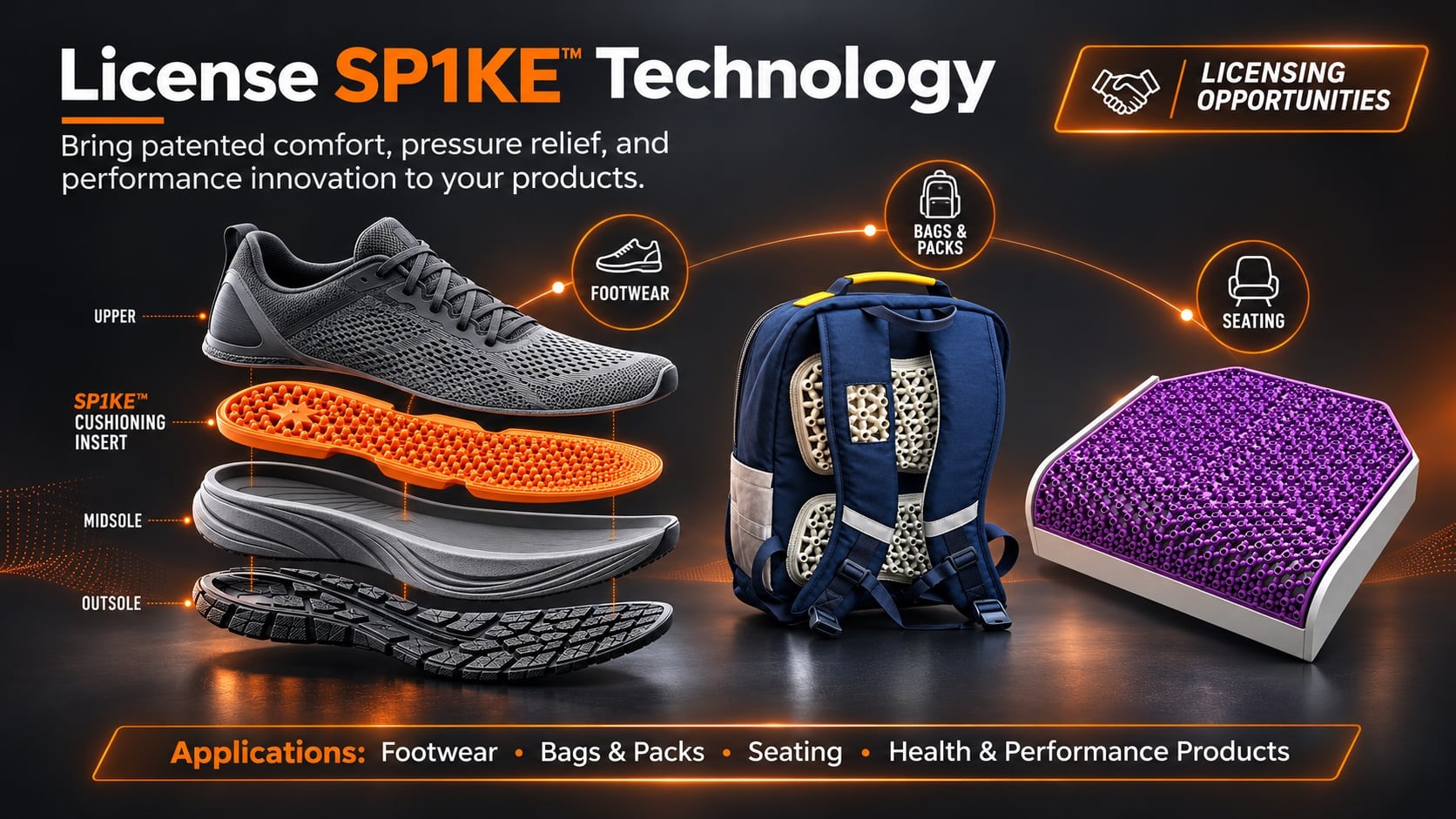
Manufacturers can explore its use in aviation seating, backpacks, footwear, sports equipment, healthcare products, and other applications.
The opportunity is straightforward: integrate innovative support technology into products customers already use.
Key Takeaways
- Technology licensing: Manufacturers can explore licensing SP1KE™ for new products or existing product improvements.
- Patented design: SP1KE™ uses a globally patented Tips & Mesh structure.
- Multiple industries: Potential applications include aviation, transportation, footwear, backpacks, sports equipment, and healthcare products.
- Dynamic support: Flexible tips respond to pressure and movement rather than relying entirely on conventional flat cushioning.
- Material versatility: SP1KE™ structures can be developed for different product requirements and manufacturing environments.
- Commercial opportunity: Licensing offers manufacturers a way to explore product differentiation through an established technology platform.
Innovation Does Not Always Mean Inventing Something New
Every manufacturer faces a similar challenge.
Customers expect products to become more comfortable, functional, durable, and efficient.
At the same time, manufacturers must control development costs, production complexity, and time to market.
Creating a completely new technology can require years of research, engineering, testing, and investment.
However, innovation does not always require starting from the beginning.
Sometimes, the opportunity lies in improving the surfaces and structures already found inside everyday products.
Consider an aircraft seat.
Its primary purpose is to support passengers during travel.
Yet the comfort experienced during a long flight depends on more than the seat’s appearance or thickness.
Pressure distribution, support, airflow, vibration, and body movement all influence the seating experience.
Similar considerations apply to backpacks, footwear, sporting goods, and healthcare equipment.
What if manufacturers could improve these products by changing the technology responsible for supporting the human body?
That is the opportunity behind SP1KE™.
What Is SP1KE™ Technology?
SP1KE™ is a patented structural technology developed to manage pressure, load, movement, and physical contact.
Unlike conventional cushioning systems, SP1KE™ does not depend entirely on a continuous, flat foam surface.
Instead, its Tips & Mesh construction combines hundreds of flexible support tips with an interconnected, open-grid structure.
The individual tips respond to pressure as the body moves.
This allows the support surface to adapt to changing loads and contact positions.
How Tips & Mesh Technology Works
The design combines three important characteristics.
- Flexible support tips
Individual tips respond to contact and movement.
Their shape allows progressive compression as pressure increases.
- An interconnected structural mesh
The open-grid design allows the support elements to move within the overall structure.
It also creates spaces that support airflow.
- Progressive resistance
As greater force is applied, the structure provides increasing resistance.
This allows the material to respond differently to lighter and heavier loads.
Together, these characteristics create a dynamic support system.
Rather than relying only on softness, the design addresses how pressure and movement interact with a support surface.
Why Dynamic Support Matters
Human bodies rarely remain completely still.
We breathe, shift our weight, change position, and respond to movement around us.
A passenger adjusts their posture during a flight.
A student walks with a loaded backpack.
An athlete moves rapidly during competition.
A worker stands for hours on a hard surface.
These activities create changing patterns of pressure and movement.
SP1KE™ technology is designed to respond to those changes.
Its flexible tips provide individual contact points that can compress and recover as loads change.
This mechanical approach creates opportunities for manufacturers developing products that support the human body.
Seven Industries That Could Benefit from SP1KE™ Technology Licensing
SP1KE™ is not limited to one product category.
Its structural design creates potential applications wherever comfort, support, pressure management, or vibration control matter.
1. Aviation and Transportation Seating
Long periods of sitting can create discomfort, especially when passengers have limited opportunities to move.
Aircraft seats must also meet demanding requirements for weight, durability, safety, and available space.
Vigurus Technologies has worked on aviation seating applications using SP1KE™ technology.
Potential development objectives include:
- Improving pressure distribution across seating surfaces.
- Supporting airflow within cushion structures.
- Managing vibration and changing loads.
- Exploring alternatives to conventional cushioning systems.
- Developing structures suited to specific seating requirements.
These principles may also interest manufacturers of railway seats, buses, commercial vehicles, and other transportation equipment.
Any commercial seating application would require testing against relevant safety and performance standards.
2. Backpacks and Load-Carrying Equipment
Backpacks place repeated pressure on the shoulders, back, and hips.
As someone walks, the backpack moves in response to the body.
That movement changes how the load contacts the wearer.
Vigurus Technologies has explored SP1KE™ applications for backpacks and load-carrying products.
Potential integration areas include shoulder straps, back panels, and hip-support systems.
Flexible Tips & Mesh structures may offer manufacturers opportunities to explore:
- Dynamic pressure distribution.
- Improved airflow between the pack and body.
- Reduced concentration of pressure at contact points.
- Flexible support during walking and running.
- Different cushioning characteristics without relying solely on conventional padding.
Applications could include school backpacks, hiking packs, travel luggage, and occupational equipment.
3. Footwear and Insoles
Footwear manufacturers continually seek ways to improve comfort and support.
Traditional shoe designs often depend on flat foam, molded cushioning, or fixed arch-support structures.
SP1KE™ offers a different mechanical approach.
Its flexible tips create numerous contact points beneath the foot.
These contact points respond to changing pressure during standing and walking.
The design also creates opportunities for tactile sensory feedback.
Potential footwear applications include:
- Athletic and recreational shoes.
- Work boots and safety footwear.
- Hiking footwear.
- Casual and everyday shoes.
- Footbeds and removable insoles.
- Specialized comfort footwear.
Manufacturers may explore integrating SP1KE™ into existing footbeds or developing entirely new footwear components.
4. Sports and Fitness Equipment
Athletes interact with supporting surfaces throughout training and competition.
These surfaces include protective equipment, exercise mats, footwear, seating, and other accessories.
Manufacturers often seek materials that balance support, flexibility, durability, and low weight.
SP1KE™ offers opportunities for product development involving dynamic cushioning and load management.
Potential applications include exercise mats, kneeling surfaces, sporting accessories, and protective support components.
Each application can be assessed according to its specific mechanical and performance requirements.
5. Healthcare and Rehabilitation Products
Pressure management is an important consideration in many healthcare environments.
Patients may spend extended periods sitting, resting, or using supportive equipment.
Healthcare manufacturers also consider hygiene, cleaning, durability, and material performance.
SP1KE™ technology offers a platform for exploring specialized support surfaces.
Potential applications include:
- Seating and positioning products.
- Rehabilitation equipment.
- Support cushions.
- Therapeutic exercise surfaces.
- Mobility-related accessories.
- Specialized patient comfort products.
Closed-cell EVA versions of SP1KE™ are designed to resist water absorption and allow convenient cleaning.
Medical applications require appropriate clinical evidence, regulatory review, and product-specific validation.
6. Office and Workplace Ergonomics
Many employees spend long periods sitting or standing.
Manufacturers of ergonomic equipment continue developing products that improve workplace comfort.
SP1KE™ structures can be explored for office seating, standing mats, foot-support products, and related accessories.
The flexible support system offers an alternative to conventional static cushioning.
Potential benefits depend on the product design, user requirements, and application.
7. Outdoor and Recreational Products
Outdoor equipment must perform in changing environments.
Moisture, dirt, repeated use, and portability are important considerations.
SP1KE™ products made from closed-cell EVA foam offer water-resistant material characteristics and washable surfaces.
Potential applications include camping equipment, portable seating, hiking accessories, fishing products, and outdoor kneeling pads.
For manufacturers, this creates opportunities to develop products that combine practical outdoor features with dynamic support technology.
Why License Technology Instead of Developing It From Scratch?
Technology licensing can provide manufacturers with access to established intellectual property and technical knowledge.
Instead of independently developing every component, manufacturers can evaluate whether an existing technology meets their product objectives.
Potential Advantages of Licensing SP1KE™
Product differentiation
A distinctive support structure can help manufacturers develop products with features beyond conventional foam cushioning.
Access to patented intellectual property
Licensing provides a commercial framework for using protected technology within agreed applications and markets.
Development flexibility
Manufacturers can explore different shapes, configurations, and product integrations.
Potential development efficiencies
An existing technology platform may reduce some early research requirements.
However, product-specific engineering, testing, and validation remain necessary.
New product opportunities
The same technology platform may support multiple applications within a manufacturer’s portfolio.
Long-term innovation partnerships
Licensing can support continued collaboration between technology developers and manufacturing partners.
How SP1KE™ Differs From Conventional Cushioning Materials
Traditional cushioning materials remain useful across many industries.
However, different structures offer different mechanical characteristics.
| Feature | Conventional flat foam | SP1KE™ Tips & Mesh |
| Primary structure | Continuous cushioning layer | Flexible tips within an open grid |
| Pressure response | Depends on foam density and thickness | Individual tips compress as loads change |
| Airflow | Depends on material and design | Open spaces within the structure |
| Surface contact | Broad, continuous contact | Multiple flexible contact points |
| Load response | Based on material compression | Progressive resistance through tip geometry and material |
| Product integration | Established molding and cutting methods | Application-specific structural design |
| Sensory interaction | Depends on surface texture | Distinct tactile contact points |
Neither approach is universally suitable for every product.
The appropriate solution depends on design requirements, production methods, and performance testing.
SP1KE™ offers manufacturers an additional technology platform to evaluate.
Can SP1KE™ Be Integrated Into Existing Products?
Yes. One of the main opportunities is exploring SP1KE™ within products that manufacturers already produce.
A manufacturer may not need to redesign an entire product.
Instead, the development team can identify areas where pressure, movement, support, or airflow affect performance.
Examples include replacing a conventional backpack contact pad or developing an alternative seating support structure.
A footwear manufacturer might explore SP1KE™ within an existing footbed design.
A sports equipment company could evaluate the technology for a new protective or support component.
The integration approach depends on the product, manufacturing process, and licensing agreement.
Questions Manufacturers Should Consider
Before starting a development project, manufacturers should identify:
- What product problem needs improvement?
- Where does the product contact or support the body?
- What pressure, load, or movement conditions occur during use?
- Which materials and manufacturing processes are currently used?
- What performance standards must the finished product meet?
- How will success be measured through testing?
These questions help determine whether SP1KE™ is a suitable technology for the proposed application.
Working With Vigurus Technologies
Vigurus Technologies Inc. provides a point of contact for manufacturers interested in exploring SP1KE™ technology licensing.
The process begins with understanding the manufacturer’s product and development objectives.
Step 1 — Explore the Application
The manufacturer identifies the product category, intended users, and desired improvements.
This may involve an existing product or a completely new concept.
Step 2 — Evaluate Technical Suitability
The parties explore whether SP1KE™ structures could meet the application’s requirements.
Material selection, geometry, manufacturing compatibility, and performance objectives may be considered.
Step 3 — Discuss Development and Licensing
If the application appears suitable, the parties can discuss technical collaboration and potential commercial terms.
Licensing arrangements may address fields of use, territories, intellectual property rights, and other business requirements.
Step 4 — Develop and Validate
The manufacturer evaluates prototypes and conducts appropriate product testing.
Performance, durability, safety, regulatory requirements, and manufacturing feasibility must be established before commercialization.
Step 5 — Explore Commercial Production
Following successful development and an agreed licensing arrangement, the manufacturer can pursue production and market introduction.
The exact process depends on the project and partnership.
Frequently Asked Questions About SP1KE™ Technology Licensing
Can any manufacturer apply to license SP1KE™ technology?
Manufacturers from different industries can contact Vigurus Technologies to discuss potential licensing opportunities. Suitability and commercial terms are evaluated individually.
Is SP1KE™ only available for insoles and exercise mats?
No. The technology can be explored for seating, backpacks, sports equipment, healthcare products, and other applications involving physical support.
Can SP1KE™ improve an existing product?
Potentially. Manufacturers can evaluate replacing or enhancing existing support components with SP1KE™ structures.
Is SP1KE™ technology patented?
Yes. SP1KE™ is supported by a global patent portfolio. Specific patent rights and licensing availability depend on the application and territory.
Can manufacturers customize SP1KE™ structures?
Application-specific configurations may be explored. The available options depend on technical requirements, intellectual property rights, and the licensing agreement.
Does SP1KE™ technology require special manufacturing equipment?
Manufacturing requirements depend on the structure, materials, and intended application. Technical feasibility should be assessed during product development.
Can SP1KE™ be used in medical products?
Potential applications can be evaluated. Medical uses may require clinical validation, regulatory approval, and other product-specific requirements.
How can a manufacturer begin a licensing discussion?
Manufacturers can contact Vigurus Technologies through its website to introduce their company, product application, and development objectives.
The Future of Product Innovation May Begin With Better Support
Everyday products are continually evolving.
Manufacturers improve materials, reduce weight, refine designs, and respond to changing customer expectations.
Yet the surfaces that support the human body remain an important area for innovation.
SP1KE™ offers a different approach through flexible support tips, open-grid construction, and progressive resistance.
The technology can be explored across multiple industries without being limited to one finished product.
For manufacturers, this creates an opportunity to rethink existing designs and investigate new applications.
Innovation does not always require replacing an entire product.
Sometimes, changing one essential component can open the door to a new product experience.
Explore SP1KE™ Technology Licensing Opportunities
Whether your company manufactures seating, footwear, backpacks, sporting goods, or specialized support equipment, we welcome conversations about new applications.
Learn more about Vigurus Technologies and the SP1KE™ technology platform.
Interested in exploring a licensing partnership?
Visit Vigurus Technologies to connect with our team and discuss your manufacturing objectives.
Better products can begin with a different approach to support.